Category: Customer Experience Design

What You Can Learn About Chat From Amazon’s Chat Agents

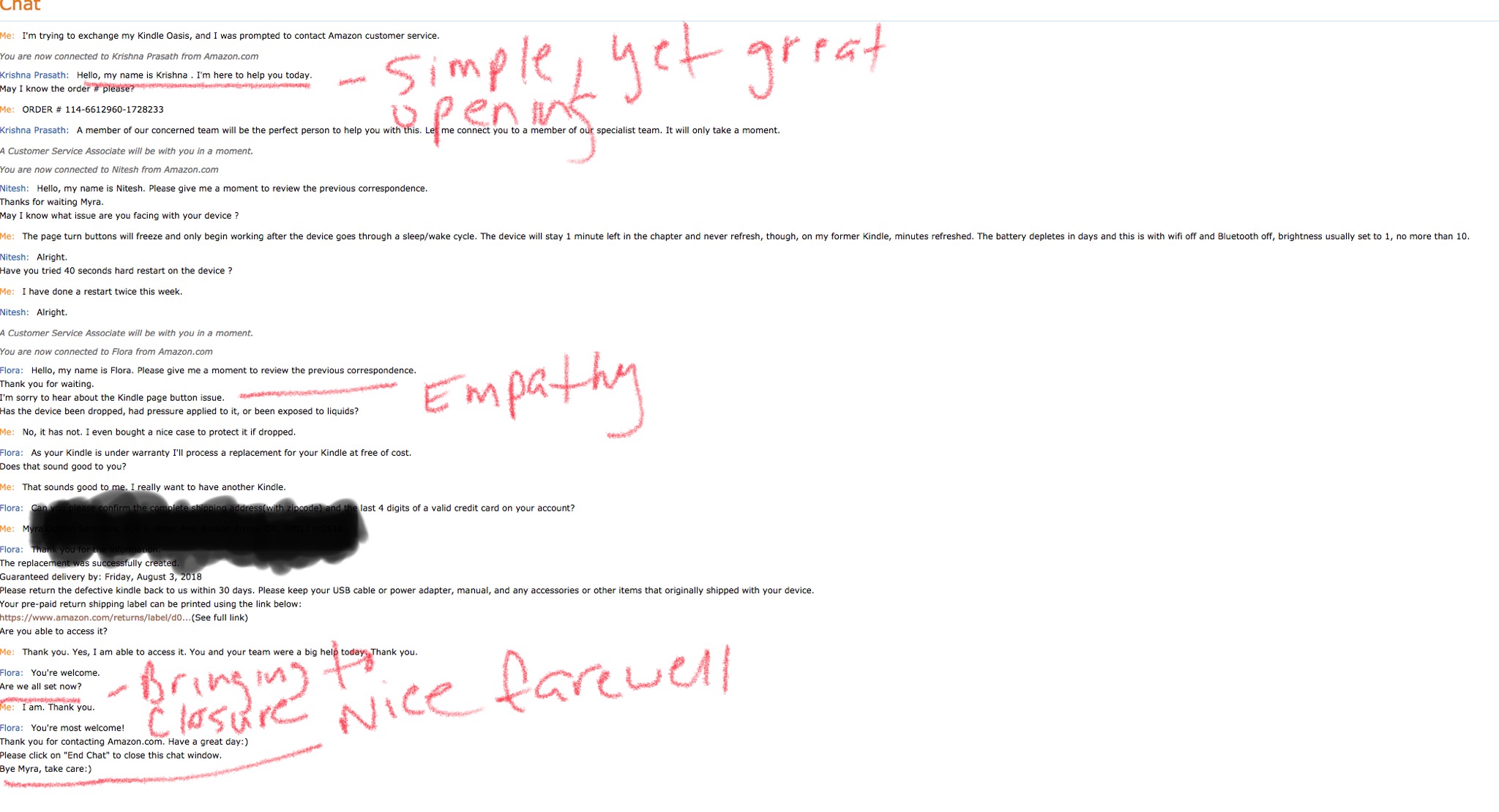
Last week I worked with a fantastic new client in Cleveland on the chat customer experience. After my workshop in Ohio, I chatted with Amazon about a problem with my Kindle Oasis.

I immediately made screenshots of my chat and sent the images to my Cleveland client. I hope that my takeaways might help my customer as they prepare to go live with chat in just a few weeks.

And then I thought, why not share my chat experience with you, too.

In this post, I have my exact chat interaction because it’s important for you to see the key points.

Click here for larger image.

Chat Example

Here’s what I want you to notice.

6 More Ways to Get An Angry Customer to Back Down

iStock-864958482.jpg

Eleven years ago, I published my first YouTube video. I called it Top 6 Ways to Get An Angry Customer to Back Down. That little video has gotten more than 2.9 million views. (I have this old-school video at the bottom of the page if you’d like to take a look.)

That video’s style, content, and quality are as far as the East is from the West from my current videos and work. But people watch it, like it, and learn from it. So, it serves its purpose.

I’ve wanted to update my Top 6 Ways to Get An Angry Customer to Back Down tactics for some time. In a few days, I’m heading to Montreal to help a new client, a team of Customer Service Representatives, get their demanding and unreasonable customers to back down. I’ve spent the last few weeks developing solid tactics and strategies for this client.

As it turns out, the tactics and techniques I’ll use in my Montreal training are an excellent update to my original Top 6 Ways to Get An Angry Customer to Back Down. So, I’m now issuing an update to these strategies and calling this Six More Ways to Get An Angry Customer to Back Down.

Maybe I’ll do a video later when I’m not delivering back-to-back workshops on the road. For now, though, I’ll merely share my new tactics.

1. Create Calm

The first thing you must do with demanding and unreasonable customers is create calm. Create calm by using anti-inflammatory words and using words that show the customer that getting to the bottom of the problem is as important to you as it is to them. Statements like these work well:

“I’m sorry you’ve had such a frustrating experience.”

“This is no more acceptable to us than it is to you.”

“Thanks for taking the time to let us know.”

“We want to get to the bottom of this as much as you do.”

Responses like these show the customer that you’re on their side. Customers won’t refute these statements, and you’ll begin to create calm.

2. Limit Your Responses to Simple Reassurances

Make Your Email Replies to Customers Easy To Read Using These 4 Tips

iStock-871802194.jpg

Most of your customers read your emails on their phones or tablets. And they’re reading your messages while they’re on the go or doing a couple of other things. Like you, your customers are busy.

You can make it easy for customers to quickly read and understand your message by doing just a few key things. Just as companies design their websites for customers to access information with just a few clicks, you need to structure your emails so that they can be quickly read and understood.

Today, I’m giving you four things you can do to make your emails easier for customers to read and understand by making them scannable.

1. Write in short sentences.

Keep your sentences to 15 -20 words. This makes your emails more scannable, as we keep in mind that many people read emails on their phones.

8 Interview Questions to Help You Hire for Emotional Intelligence In Customer Service Roles

iStock-521548648.jpg

Too many hiring managers focus on candidates’ work histories when filling customer service roles. They get excited when they read that the candidate has six-plus years of working in customer service.

But past work in customer service is not a reliable indicator of future success in serving your customers.

To consistently deliver the best possible customer interactions, you need to hire for emotional intelligence —hiring people with empathy, friendliness, and connection, and then training those people on your systems and policies. These are the people who will do the best job for you.

I will show you how to hire for emotional intelligence using eight strategic interviewing questions in this article.

The Goal In Interviewing for Customer Service Jobs

We’ll get to the interview questions in a moment. But, you must set up the interview properly for the questions to work. When interviewing candidates for customer service jobs, you want to get them relaxed and confident, so they can authentically communicate with you. Here are four things precisely for you to focus on in your interviews.

Make the Candidate Feel As Comfortable As Possible

Small talk is a fantastic way to get candidates relaxed. Talk about anything – traffic, the cup of coffee you spilled in your last meeting, or a unique piece of jewelry the person is wearing. You want candidates to relax because when people are relaxed, they are more communicative and genuine.

Get Candidates to Tell You Stories

When you ask interview questions, and I’ll give you several questions, encourage the person to provide detailed examples of how they recently handled specific situations. When candidates talk to you through stories and examples, you’ll get an honest and comprehensive insight into how the person is likely to perform in a similar situation at your company.

Laying the Interview Foundation

After making a little small talk and getting your candidate relaxed, set the interview up by saying something like, “I’m going to ask you some questions, and what I’m looking for is specific examples that illustrate how you have responded to specific situations in the past. I’ll be taking notes as you talk, but you keep going. Feel free to take your time and think about responses before answering the questions.”

Taking Notes

While your candidate is telling you stories of how they’ve handled specific situations in the past, you need to be taking lots of notes. I want you to jot things down so you can go back and closely examine how all of the people you interviewed measure up to your expectations. It will be easy to forget the many examples you’ve heard during interviews, so you must take meeting notes.

Sample Interview Questions

This One Tip Will Instantly Make You Sound Friendlier On the Phone With Customers

iStock-660765142.jpg

One of the easiest ways to make your conversations with customers more conversational and friendly is to speak in complete sentences.

It is so familiar to hear interactions like this:

Last name? First name? Zip code?

It’s undoubtedly efficient to ask customers questions in this manner. However, it’s not the friendliest approach. In this article, I’ll talk to you about instantly improving your ability to connect with customers and sound friendly by just speaking in complete sentences.

Yes, speaking in complete sentences will take a few more seconds, but it’s so worth it because of how the conversation will flow and how your customers perceive you.

When you have to ask your customer questions, I want you to do two things:

Having Trouble Controlling Conversations with Customers? This Will Help.

Shot of a young businesswoman using a laptop at work. Portrait of young black woman in creative office. Young African American female architect working in an office.

Studies show the average business call lasts 2 minutes longer than it needs to. Customer service employees struggle with call control for a variety of reasons, including they don’t want to be rude to the customer, they aren’t sure how to move to closure or because the customer is rambling or angry.

Using the principles of harmony, assertiveness and leading from the martial art Aikido, Myra walks your employees through the steps to politely and confidently control conversations.

The outcome of this training is employees who possess the soft skills to make customers feel heard and understood, politely lead conversations and assertively bring calls to closure.

Here’s a 60-second introduction to the training. If you like what you see, use the link at the bottom of this page to go directly to the full course.

Three Proactive Things You Can Do to Pre-empt an Escalation with a Customer

iStock-866661208.jpg

Tomorrow morning I’m headed to Phoenix to deliver a workshop at the Salesforce Trailblazers for the Future Conference. I booked an extra night at the Arizona Biltmore because I wanted some “me time” for relaxation and reading. I do this often, adding a day or two to a business trip to chill, explore, and enjoy local restaurants. Do you take time just for yourself?

Before I wrap things up in my office today and prepare for tomorrow’s early flight, I’m sharing with you three things you can do to pre-empt an escalation with a customer. These tips will help you handle interactions to significantly minimize the chance of a customer becoming so incensed that they feel they have to talk to a supervisor.

1. Reflect Your Brand Promise

One of my clients is a furniture protection plan company. A point of upset for many of their customers is when they discover that the damage to their furniture is not covered under warranty. Customers get intensely agitated because they feel what they purchased is not the same as the service they receive. I encouraged agents in this company to reflect the brand promise in every interaction. I had them focus on explaining first what the protection plan covered and then quickly going over a few of its many benefits.

Instead of merely telling the customer that their damage was not covered, I instructed agents to say something like,

“You have an excellent plan here. It covers such things as scratches and broken pieces. In this case, we do not cover discoloration of the leather, as fading is a natural occurrence that comes from body oils and usage. If anything else should come up, though, please give us a call, and we’ll be happy to look into things for you.”

Reflecting the brand promise, in this situation, is reminding the customer of the many benefits the protection plan does offer and by serving customers with a friendly demeanor.

2. Don’t Push

Trying to Hire Millennial Employees for Customer Service Roles? Make Sure You’ve Mastered These 3 Things First.

Manager in business attire

One of the most significant challenges facing companies today is attracting and retaining right-fit front-line customer service professionals. This is challenging, but you can find and keep good-fit employees if you know what’s important to Millennials as it relates to the job search and company culture.

Millennials now make up about 50% of the workforce. And Millennials approach jobs and careers differently from Generation X (my generation) and Baby Boomers.

When I work with companies on finding, hiring, and retaining the best customer service employees, I focus on three things.

1. Developing an attractive social presence (This is tremendously important merely to get Millennials to consider a company.)

2. Hiring for motivational fit. You want people who are motivated to deliver exceptional customer interactions, people who are the best cultural fit for your brand and your customers.

3. A solid coaching and motivation strategy. You’re going to have to coach to develop your people because this is extremely important to Millennials.

Let’s look at each of the three elements of attracting, hiring, and retaining Millennials.

4 Keys to Delivering Lousy News to Customers

iStock-638601718.jpg

I’m sipping black tea and listening to classical music while I custom design a customer service workshop for a utility on the east coast. One of my deliverables for this training is to equip employees with the skill of giving lousy news to customers in such a way that the customer accepts the employees’ answer as the final word.

You’re in for a professional development treat today, because I’m sharing with you what I’ll facilitate in Philadelphia next month. You’re about to learn how to deliver bad news with confidence and in such a way that you minimize backlash from customers.

You can give a customer bad news easily and without fear of how your customer might respond when you use 4 Keys. When you have to deliver bad news to your customer, you need to:

Say what you have to say Assertively

Acknowledge how hard this is for the customer

Manage Expectations

Offer Options, when it makes sense


Let’s look at each key.

Key 1: Say What You Have to Say Assertively