Author: myragolden

Myra is a favorite training partner to Fortune 500 companies with her customized, engaging, behavior-changing (and fun) customer service workshops, working with McDonald’s, Coca-Cola, Frito-Lay, Michelin, Vera Bradley and other brands.

When Employees Make Assumptions, It Hurts Your Business. Here’s How to Fix That.

Smiling teenage girl pointing up with her finger

Recently, I went to buy a replacement charging cable for my laptop. I found a salesperson and told him what I needed. I should also mention that when I approached the employee, he was fully engaged with his cellphone. I felt like I interrupted him.

Looking annoyed, he turned around and grabbed a cable off the shelf and handed it to me. It didn’t look like what I had before, so I asked, “Are you sure this is the cable for my laptop?”  He said, “That’s it.”

I got the cable home, and it didn’t fit.

This employee heard parts of what I said and then just filled in the gaps with assumptions. He assumed he knew what I needed without asking me any follow-up questions.

His assumptions led to me being frustrated, and I had to make a second trip into the store. His assumption led to me having a very poor customer experience.

In my customer service workshops, I teach your employees how not to make assumptions, and I explain this concept in an unforgettable way. I show this short video called “The Cookie Thief.”

Do These 2 Things To Make Chat Interactions Pleasant and Easy

iStock-486985314.jpg

When I need to contact a company, chat is almost always my preferred contact method. It’s usually quick, and I can do other things, like replying to emails or making a quick call while I chat.

Your customers like the ease of chat, too. But it’s not enough for the chat to be convenient and fast. You need to be creating rapport in conversation and speaking your brand voice. That’s why today I am giving you two things you (or your employees) can do to make chat interactions flow like friendly face-to-face conversations.

1. Use Personal Pronouns

Use personal pronouns, I, we, me, you – to make written communication sound more warm and personal. Pronouns, especially “I” and “you” – humanize the employee and the customer, and they bring a personal tone to a chat exchange.

Use personal pronouns in your chat like this actual chat I had last week:

“Oh, Myra, I am so sorry to hear that you received expired products! I credited $7.38 to your account, which will be automatically applied to your next order.”

And don’t write like this:

Try These 2 Things To Foster Rapport Over the Phone with Customers

iStock-487813922.jpg

For all of my customer service workshops, I like to arrive at least 45 minutes before we start so I can meet and talk to the people who’ll be spending several hours with me.

Screen Shot 2018-02-28 at 10.44.59 AM

In the past, I’d just hang out in the back of the room, and I’d approach the front only after I was introduced.

But I’ve found that talking to workshop participants before the training starts helps me to connect with my audience before I speak my first word. It makes me more real to the audience, and more likable, and the training goes so much better after this rapport-building.

Just as taking the time to build rapport before my workshops makes a big difference, when you establish rapport with customers, the perception of the interaction is so much more positive.

We have a short video in my customer service eLearning suite that shows you how to use two super-easy techniques to build rapport over the phone. If you, or someone you know, can use a little help with rapport over the phone, watch this short movie now.

Here’s What’s In the Mind of Your Unreasonable Customer

iStock-486649694.jpg

When a customer reaches out to you about a problem, they usually don’t think things will be easy. They expect to enter a fray.

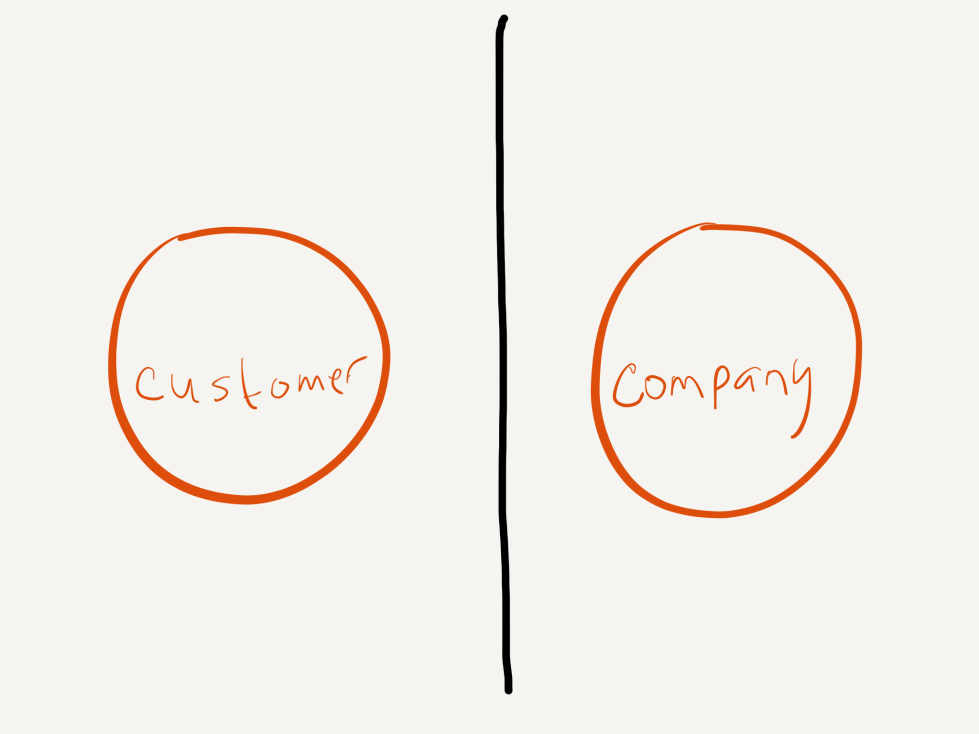
To customers, it’s them against you.

Paper.Untitled.3

Visually, it’s like this. There’s a brick wall between you and your customer. You are on one side of the wall, and your customer is on the other.

The average phone call with customers lasts two minutes longer than it needs to. Here’s how to fix that.

iStock-479753858.jpg

I read that the average customer service call lasts two minutes longer than it needs to. And from personal experience in my own business and my years of customer service work, I believe this.

Twenty years ago I began teaching a conversation control technique called Ask 3 Closed-ended Questions Back-to-Back.

I learned the technique from a consultant I hired to work with my employees in a call center in Tulsa. This consultant, Sally Cox, had trained police officers to immediately assert their authority over situations. Sally taught my people some of the same things she taught law enforcement.

Sally taught my team to instantly regain control of a conversation with a customer, and move the call to closure by asking the customer three closed-ended questions back-to-back.

Here’s how the technique works.

What You Can Learn About Chat From Amazon’s Chat Agents

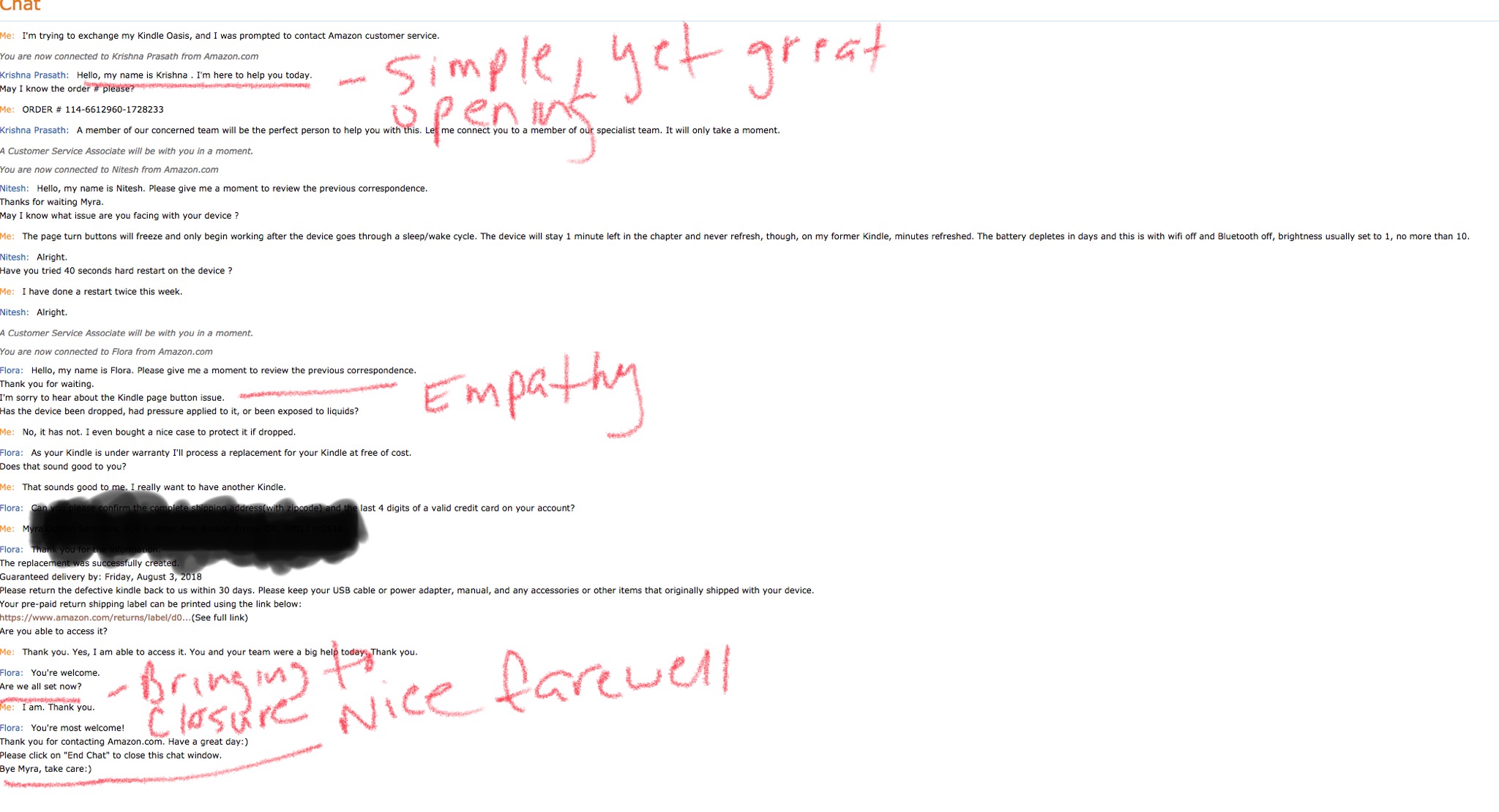
Last week I worked with a fantastic new client in Cleveland on the chat customer experience. After my workshop in Ohio, I chatted with Amazon about a problem with my Kindle Oasis.

I immediately made screenshots of my chat and sent the images to my Cleveland client. I hope that my takeaways might help my customer as they prepare to go live with chat in just a few weeks.

And then I thought, why not share my chat experience with you, too.

In this post, I have my exact chat interaction because it’s important for you to see the key points.

Click here for larger image.

Chat Example

Here’s what I want you to notice.

6 More Ways to Get An Angry Customer to Back Down

iStock-864958482.jpg

Eleven years ago, I published my first YouTube video. I called it Top 6 Ways to Get An Angry Customer to Back Down. That little video has gotten more than 2.9 million views. (I have this old-school video at the bottom of the page if you’d like to take a look.)

That video’s style, content, and quality are as far as the East is from the West from my current videos and work. But people watch it, like it, and learn from it. So, it serves its purpose.

I’ve wanted to update my Top 6 Ways to Get An Angry Customer to Back Down tactics for some time. In a few days, I’m heading to Montreal to help a new client, a team of Customer Service Representatives, get their demanding and unreasonable customers to back down. I’ve spent the last few weeks developing solid tactics and strategies for this client.

As it turns out, the tactics and techniques I’ll use in my Montreal training are an excellent update to my original Top 6 Ways to Get An Angry Customer to Back Down. So, I’m now issuing an update to these strategies and calling this Six More Ways to Get An Angry Customer to Back Down.

Maybe I’ll do a video later when I’m not delivering back-to-back workshops on the road. For now, though, I’ll merely share my new tactics.

1. Create Calm

The first thing you must do with demanding and unreasonable customers is create calm. Create calm by using anti-inflammatory words and using words that show the customer that getting to the bottom of the problem is as important to you as it is to them. Statements like these work well:

“I’m sorry you’ve had such a frustrating experience.”

“This is no more acceptable to us than it is to you.”

“Thanks for taking the time to let us know.”

“We want to get to the bottom of this as much as you do.”

Responses like these show the customer that you’re on their side. Customers won’t refute these statements, and you’ll begin to create calm.

2. Limit Your Responses to Simple Reassurances

Make Your Email Replies to Customers Easy To Read Using These 4 Tips

iStock-871802194.jpg

Most of your customers read your emails on their phones or tablets. And they’re reading your messages while they’re on the go or doing a couple of other things. Like you, your customers are busy.

You can make it easy for customers to quickly read and understand your message by doing just a few key things. Just as companies design their websites for customers to access information with just a few clicks, you need to structure your emails so that they can be quickly read and understood.

Today, I’m giving you four things you can do to make your emails easier for customers to read and understand by making them scannable.

1. Write in short sentences.

Keep your sentences to 15 -20 words. This makes your emails more scannable, as we keep in mind that many people read emails on their phones.

8 Interview Questions to Help You Hire for Emotional Intelligence In Customer Service Roles

iStock-521548648.jpg

Too many hiring managers focus on candidates’ work histories when filling customer service roles. They get excited when they read that the candidate has six-plus years of working in customer service.

But past work in customer service is not a reliable indicator of future success in serving your customers.

To consistently deliver the best possible customer interactions, you need to hire for emotional intelligence —hiring people with empathy, friendliness, and connection, and then training those people on your systems and policies. These are the people who will do the best job for you.

I will show you how to hire for emotional intelligence using eight strategic interviewing questions in this article.

The Goal In Interviewing for Customer Service Jobs

We’ll get to the interview questions in a moment. But, you must set up the interview properly for the questions to work. When interviewing candidates for customer service jobs, you want to get them relaxed and confident, so they can authentically communicate with you. Here are four things precisely for you to focus on in your interviews.

Make the Candidate Feel As Comfortable As Possible

Small talk is a fantastic way to get candidates relaxed. Talk about anything – traffic, the cup of coffee you spilled in your last meeting, or a unique piece of jewelry the person is wearing. You want candidates to relax because when people are relaxed, they are more communicative and genuine.

Get Candidates to Tell You Stories

When you ask interview questions, and I’ll give you several questions, encourage the person to provide detailed examples of how they recently handled specific situations. When candidates talk to you through stories and examples, you’ll get an honest and comprehensive insight into how the person is likely to perform in a similar situation at your company.

Laying the Interview Foundation

After making a little small talk and getting your candidate relaxed, set the interview up by saying something like, “I’m going to ask you some questions, and what I’m looking for is specific examples that illustrate how you have responded to specific situations in the past. I’ll be taking notes as you talk, but you keep going. Feel free to take your time and think about responses before answering the questions.”

Taking Notes

While your candidate is telling you stories of how they’ve handled specific situations in the past, you need to be taking lots of notes. I want you to jot things down so you can go back and closely examine how all of the people you interviewed measure up to your expectations. It will be easy to forget the many examples you’ve heard during interviews, so you must take meeting notes.

Sample Interview Questions

This One Tip Will Instantly Make You Sound Friendlier On the Phone With Customers

iStock-660765142.jpg

One of the easiest ways to make your conversations with customers more conversational and friendly is to speak in complete sentences.

It is so familiar to hear interactions like this:

Last name? First name? Zip code?

It’s undoubtedly efficient to ask customers questions in this manner. However, it’s not the friendliest approach. In this article, I’ll talk to you about instantly improving your ability to connect with customers and sound friendly by just speaking in complete sentences.

Yes, speaking in complete sentences will take a few more seconds, but it’s so worth it because of how the conversation will flow and how your customers perceive you.

When you have to ask your customer questions, I want you to do two things: